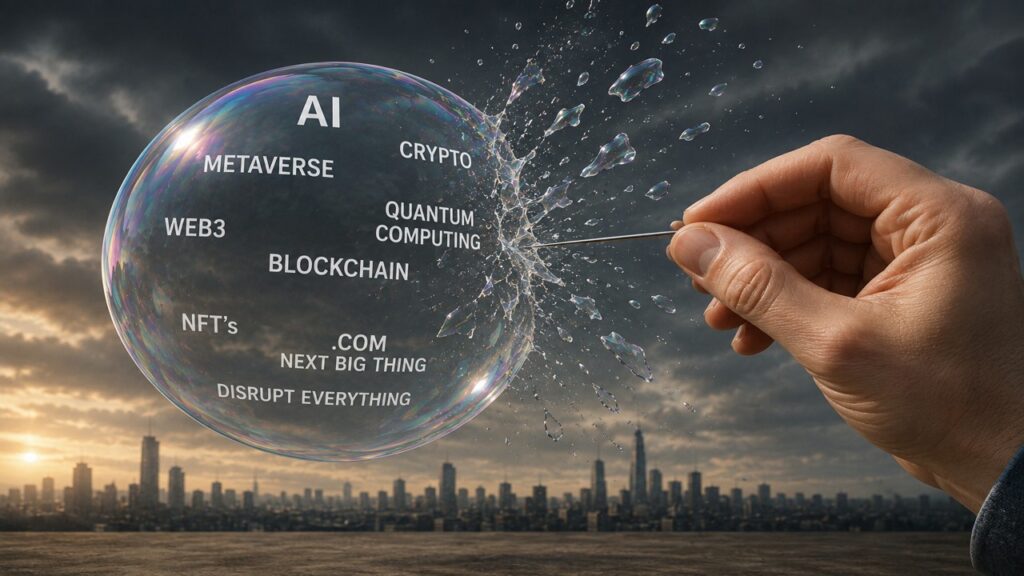
Bubbles with a Legacy
It may sound strange, but history shows it time and again. Around 1850, a railway mania swept through the financial markets. Investors poured fortunes into railway lines that would never become profitable. Around 1900, the same happened with electricity companies. And at the end of the last century, the internet seemed destined to make every existing business model obsolete. Each time, the financial bubble burst. Yet each time, something far more valuable remained: an infrastructure on which a new economy could emerge. That is why I am optimistic about artificial intelligence—not about the current AI hype, but about what comes after it.
Today, hundreds of billions are being invested in data centres, chips and software. Ultimately, these investments rest on one central assumption: AI will replace human workers. Companies will soon be able to perform the same work for a fraction of today’s labour costs. This narrative has become so common that it is almost taken for granted. Yet there are good reasons to question it.
The Limits of AI
First, there is a very practical problem. The leap towards truly reliable intelligence is far less straightforward than is often assumed. More computing power and larger training datasets may make AI better at predicting words. But that does not automatically mean AI will evolve into a system capable of taking over everyone’s job.
An increasing share of the available training data now consists of texts previously generated by AI itself. In other words, the system is increasingly learning from its own output. Imagine a library in which more and more books are merely summaries of other summaries. It is a form of digital inbreeding, with comparable consequences. Researchers increasingly recognise this as a serious problem, and convincing solutions have yet to emerge.
Early practical experience points in the same direction. Lawyers have had to explain court filings in which AI had fabricated legal precedents. Companies that enthusiastically laid off employees because AI was expected to replace them later found themselves scrambling to hire people back. Reality is proving to be more stubborn than the presentations coming out of Silicon Valley.
The Sandwich
Discussions about AI and employment also contain a second mistake. We tend to think of jobs as if they were indivisible units—as though AI could simply replace an accountant, a lawyer or a physician. That is a fundamental misunderstanding. A job is more like a sandwich: a bottom slice, a filling and a top slice.
The bottom slice is the initial interaction. Someone has to listen, ask the right questions, understand the context and determine what is actually needed. That requires trust, empathy and judgement. The filling is the execution: analysing information, writing a report, performing calculations or retrieving data. That is the part AI can often take over. The top slice is the evaluation. Someone has to explain the outcome, take responsibility and place the result in the context of a client, patient, colleague or judge. That, too, requires human judgement.
AI does not produce complete sandwiches. It automates the filling. Those who look only at the filling see jobs disappearing. Those who look at the whole sandwich see work changing in nature: from execution to understanding, evaluation and responsibility.
Now imagine that a sandwich shop buys a machine capable of preparing the filling in a fraction of the time—one hundred sandwiches per minute instead of ten. An impressive innovation. But if only two hundred customers walk in that day, very little changes. The machine prepares sandwiches faster, but demand does not increase as a result. The shop is left with a magnificent machine and a pile of unsold sandwiches.
That is the second mistake behind the AI hype. The fact that AI can produce a thousand reports in an hour does not mean there is demand for a thousand reports. Increasing production capacity does not automatically create demand. More often than not, demand—not production capacity—is the real constraint.
When the Bubble Bursts
It is therefore a mistake to believe that more computing power and more training data will automatically produce digital colleagues capable of taking over most of our work. Yet that is precisely what makes me optimistic.
If today’s financial expectations fail to materialise, the bubble will burst. Whether that happens tomorrow or five years from now, nobody knows. At that point, we may well see a global stock market crash in which many people lose large amounts of money. But the chips, the data centres and the fibre-optic networks will not disappear. They will still be there.
And that is when something far more interesting comes into view. Society will gain access to an extraordinarily powerful and inexpensive digital infrastructure. The central question will shift from “How can we replace people?” to “Which problems can we now solve that were impossible to solve yesterday?” This opens unprecedented opportunities for developers, scientists, artists, physicians and civil society organisations.
But that immediately raises another question. What happens to this AI infrastructure once the financial dust has settled? Who will own this new digital infrastructure? Who will decide who gains access to all that computing power, those data centres and those AI platforms?
That is the real challenge for policymakers. Not only to prepare contingency plans for an expected economic shock, but above all to think about what happens after the bubble. Following a wave of bankruptcies, mergers and restructurings, data centres, AI platforms and enormous computing capacity could end up being sold for next to nothing into the hands of a small number of dominant players. That would be a historic missed opportunity.
Instead, governments should ensure that this infrastructure also becomes accessible to universities, schools, hospitals, research institutes, civil society organisations and innovative start-ups. Not by nationalising everything, but by developing rules today that guarantee open access, public availability and a fair transition after the bubble has burst.
Technological bubbles always leave behind two legacies: a financial hangover and a new infrastructure. That is the irony of technological revolutions. Speculators pay for the infrastructure; society eventually reaps the benefits.
 Peter van der Wel (12026)
PS: As an economist and futures researcher, I tend to view technological developments within their broader economic and societal context. That explains why this article approaches AI primarily from an economic and political perspective, focusing on the economy that may emerge after the AI bubble.
This article was first published in Civis Mundi, August 2026.
Do you agree with the message of this blog? Feel free to share it on social media or forward it to a colleague or friend who might find it interesting. If someone forwarded it to you, you can subscribe free of charge to receive future blog posts.
PPS: Comments are always welcome. You can send them to me by email.